
Application Background
The first-stage planet carrier is one of the components in wind power gearboxes featuring complex manufacturing processes and high machining precision. Typically serving as the low-speed input end of the gearbox, it does not transmit torque directly but mainly functions to support the planetary gear train and transfer motion. The two parallel interconnected holes machining of wind power planet carriers requires large diameter sizes, high precision, and strict geometric tolerances, which directly determine the transmission accuracy, operational stability, and service life of the gearbox.
This case study introduces Worldia’s custom-engineered PCBN inserts for the precision boring of bearing mounting holes in first-stage planet carriers. Replacing the original international brand of cutting tools, our solution enables customers to extend tool life, reduce tool change frequency, and cut down on tool costs amid fierce market competition.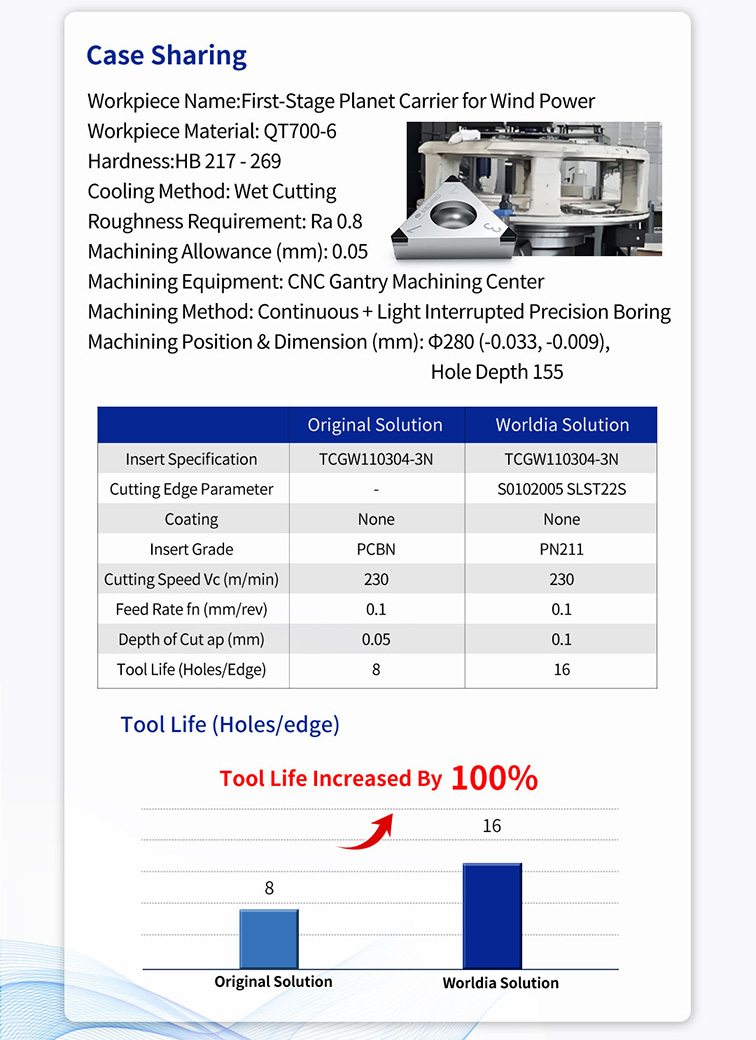
Solution Analysis
◎ In this case, the planet carrier is made of QT700-6, a material with high hardness and fatigue strength. Based on the customer’s specific machining conditions, Worldia provided a tailor-made cutting tool solution. Compared with the original tool solution, the tool life has been doubled.
◎ Given the process characteristics of only 0.1 mm machining allowance and minor interrupted cutting, Worldia engineers selected the PN211 grade material—which balances toughness and wear resistance—according to the workpiece material and process requirements. They also designed a custom non-standard cutting edge adapted to the actual working conditions, creating a fully customized PCBN cutting tool solution. This solution has helped the customer extend tool life, reduce tool change frequency, and lower overall tool costs.
◎ Relying on its strong technical capabilities, Worldia closely integrates customers’ actual machining needs with its own product advantages. The custom-engineered superhard inserts provided can help customers reduce consumable costs economically and accurately without the need to replace the main tool holder, thus achieving localization of cutting tools.