
High-volume aluminum turning is a process that requires consistency as much as speed. The turning tool must be able to control the built-up edge, the chip, surface finish, part dimensions, tool life and changeover variation. High-volume turning with PCD turning tools requires qualification of tool geometry and cutting edge quality, insert seating, as well as cooling lubrication and machine stability. The hard cutting edge of PCD turning tools is not the main advantage. The main advantage is the consistent production of abrasive or high-silicon aluminum parts within a repeatable production window.
Why Does High-Volume Aluminum Turning Need a Different Tooling Strategy?
How Does Cycle-Time Consistency Affect Tool Selection?
Just because a tool can make one good part does not mean it can be used in a production cell. A production line of high-volume parts requires, among other things, constant cycle time, stable offset, repeatable set-up, and sufficient edge life to avoid too much set-up time. Small variations in edge condition or tooling position can cause large losses when making thousands of parts.
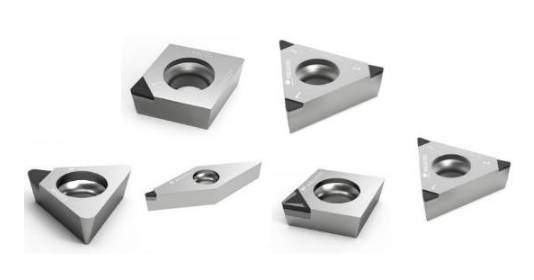
An evaluation of PCD turning tools should also consider machine downtime, number of adjustments, number of rejected parts and the planned changeover time of tools. While cutting speed is an important factor, a process that is run slightly slower and is more stable will probably produce more acceptable components per shift than a process that is run at the upper limits and requires constant intervention.
Which Chip-Control Problems Appear at Production Volume?
Aluminum produces long, ductile chips that can wrap around the part, mark finished surfaces, interfere with automated processing or prevent accurate gauging. The cutting edge, rake, and chipbreaker all influence the formation of chips. In addition, feed, depth of cut, and coolant direction must be considered. Work is interrupted when facing, profiling, boring, or turning.
Verification of the Chip control should be performed at the beginning of the planned edge-life interval as well as near its end. A geometry only working with new edges is not necessarily adequate for production stability as edges wear.
What Does PCD Contribute to Aluminum Turning?
What Is the PCD Insert Full Form?
The PCD insert full form is polycrystalline diamond insert. PCD consists of diamond grains that are bonded together to form a cutting material, and is typically supported by a carbide substrate in a tipped PCD insert. The PCD insert is hard, abrasion-resistant, and produces a fine cutting edge. It is commonly used in machining aluminum alloy with silicon abrasive particles, and requires a consistent surface finish.
Although diamond is one of the hardest materials known, PCD is not chosen solely on the basis of hardness. PCD has low affinity for many non-ferrous materials, and also has edge retention, thus preventing the built-up edge and subsequent gradual deterioration of finish. The actual effect of PCD, however, will depend on the material of alloy being used, the edge preparation, the machine itself and the lubrication.
Why Do PCD Tools Fit Non-Ferrous Aluminum Components?
PCD tools are suitable for many applications involving aluminum, copper-alloy, graphite and composite workpieces, but not for most ferrous workpieces because of the potential for diamond to react with iron at cutting temperature. In aluminum turning, a polished rake face and a controlled cutting edge are important to allow for free chip flow and a clean surface.
This material category is merely a starting point. Cast aluminum alloys are different from wrought aluminum alloys and even silicon content in aluminum can affect abrasiveness. It is essential to verify the exact aluminum alloy, heat treatment, casting skin, interrupted features etc., required by the engineer to select the best tool for the required surface requirement.
How Should PCD Turning Inserts Be Selected for Process Stability?
Which Insert Geometry and Edge Conditions Control Chip Flow?
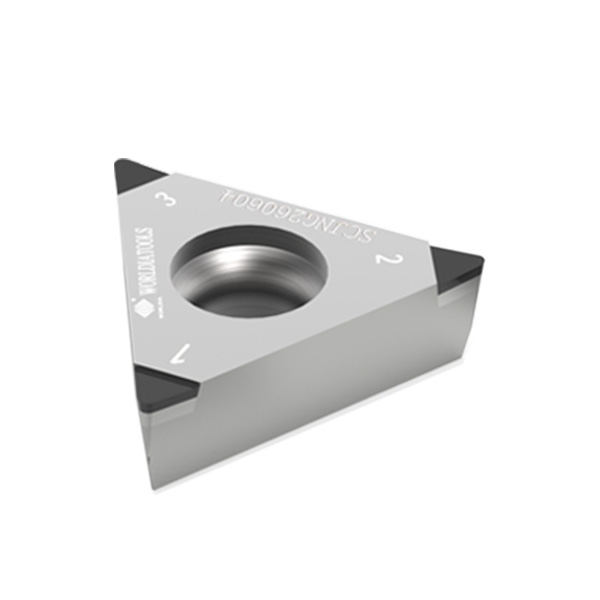
The characteristics of the nose, the edge rake, hone, chip control and cutting edge finish all affect the forces and the resulting chip. A sharp and polished cutting edge can help prevent material from sticking to it. Sometimes a robust cutting edge is required when turning components with interruptions or when the workpiece stock is not very stable. When choosing PCD turning inserts, it is essential to match them to the actual working conditions, i.e., the chosen feed and depth of cut, as opposed to just choosing an insert of the right shape.
The surface-finish targets must also be considered when selecting the nose radius. Although a larger nose radius will result in better theoretical surface finish, the increased radial forces will cause excessive vibration of slender components. A compromise must be found between surface finish, chip control, edge strength and component rigidity.
How Do Runout and Seating Affect PCD Insert Installation?
The phrase “pcd insertion” is more accurately expressed as PCD insert installation in English technical language. The effective cutting position is determined by several important factors, including the pocket’s cleanliness and contact face’s condition, as well as the clamping torque, the insertion’s orientation and the holder’s runout. In many cases, a production line may need to be set up with new offsets for every new edge, even if the edge itself is consistent.
A good changeover study would include measurements of the first part after having indexed or changed it over, the amount of offsetting required, and the time to get back to production. Installation repeatability is a feature of the tooling system that can be measured.
How Should Value Be Measured Across a High-Volume Turning Cell?
Do Longer Tool-Life Intervals Always Improve Output?
Long tool life is of little value if quality does not remain stable over the same time frame. Cutting edges that continue to cut long after surface quality and dimension accuracy have deteriorated do not add any value to productive life. An end-of-life criterion for tools should be defined on the basis of acceptable parts, wear, surface quality and process capability.
When comparing PCD turning tools, consider the cost per acceptable component, not just the cost of the edge. The cost of planned changeovers, machine downtime, operator intervention and scrap can often far exceed the cost of the insert.
Which Metrics Connect Tool Changes with Cost and Quality?
Some useful metrics for a machining process are: components per edge, dimensional capability, roughness trend, chip control, changeover time, number of adjustments, spindle load and number of unplanned stoppages. They give an indication of the real stability of the process over shifts and lots.
A controlled test using appropriate test material and a sufficient number of test pieces should be conducted in order to allow slow wear to develop. Coolant or minimum-quantity lubrication, test holder, cutting data and test inspection should be recorded in order to allow the test to be re-created.
How Does Worldia Support PCD Tool Qualification?
How Can a Supplier Match PCD Turning Tools to the Component?
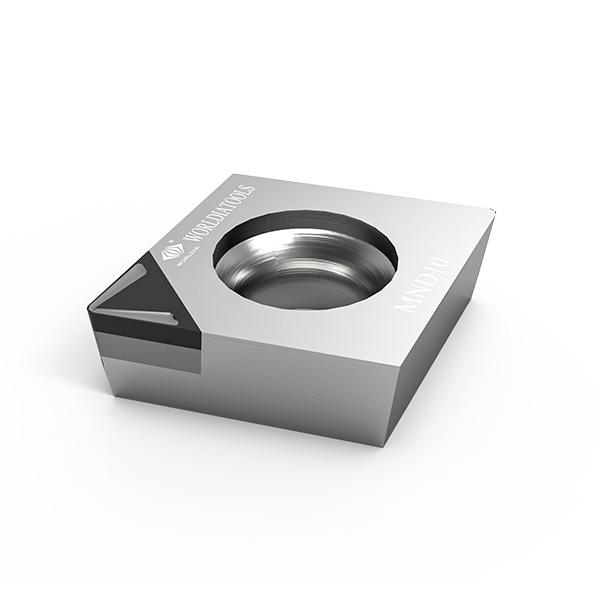
Em Mundial, we specialize in PCD tooling for non-ferrous materials such as aluminum and produce superhard tools with application-oriented engineering support. To select PCD tooling for a specific job, we review the drawing, material, allowance, machine interface, cut, chip-control needs, and acceptance criteria. We then determine the edge geometry and tool format for the operation rather than recommending a diamond grade in isolation.
What Evidence Should Be Collected During Production Trials?
We can support a trial that measures edge wear, part dimensions, surface quality, chip formation, tool-change repeatability and acceptable output. Support for traceable manufacturing and controlled critical processes is also available to enable analysis of delivery-to-delivery variations by the production team.
The purpose of this trial is to establish a reliable operating window. PCD turning tools can only be declared to be optimal by a supplier after they have been tested under the buyer’s actual production conditions and compared with alternative concepts offered by the same supplier.
FAQ
Q: Are PCD Turning Tools Suitable for Every Aluminum Alloy?
A: Some No’s have variations in alloy composition, silicon content, casting skin, interruptions, and surface finish that require specific geometry and cutting data review for each particular application.
Q: When Should a Team Choose a PCD Insert Instead of Carbide?
A: At high volumes of production, abrasive wear, built-up edge, finish drift and frequent carbide changes can become a problem that is overcome by using PCD tools. A production trial must confirm the cost-effectiveness, however.
Q: Which PCD Trial Metrics Matter Most in High-Volume Production?
A: Track acceptable parts, monitor edge, dimensional and surface trends, monitor chips, track changeover repeatability, track adjustment time, track downtime and track cost per acceptable part.